The prenatal foundations of kin recognition
4 Mar 2026· ,,,,·
1 min read
,,,,·
1 min read
Yorick Lambreghts
Martin J. Whiting
Tobias Uller
Camilla M. Whittington
Geoffrey M. While
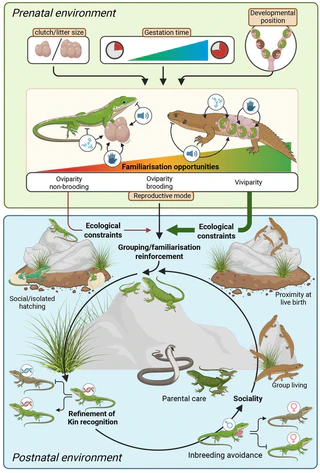
Kin recognition, the ability to identify genetic relatives, relies on familiarisation for the creation of recognition templates. During development, parent and embryo(s) are exposed to chemical, auditory, and tactile cues that can communicate reliable genetic information. We discuss how these cues can have organisational effects during a time of heightened phenotypic sensitivity, creating postnatal kin preferences. As familiarisation is often determined by the prenatal social environment, we argue that reproductive traits that alter the social context of the prenatal environment, such as reproductive mode, could facilitate the evolution of kin recognition. Furthermore, we outline how these effects of prenatal familiarisation can extend beyond kin recognition and play a pivotal role in the emergence and evolution of complex social behaviours.

Authors
Yorick Lambreghts
(he/him)
Behavioural ecologist
Yorick Lambreghts is an honorary postdoctoral fellow at Macquarie University in Sydney, Australia.
His research spans social behaviour, genetics, and conservation, focussing on how animals communicate and cooperate, how these interactions shape their evolution, and how they can adapt to changing environments.